
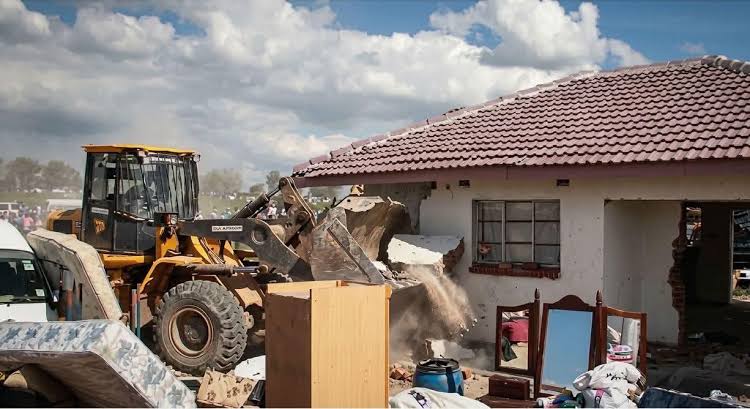
Zimbabwe Human Rights Commission (ZHRC) has called on government and local authorities to adopt a lawful and humane approach to the ongoing demolition of illegal housing structures in Harare and other urban centers, warning that the exercise could leave affected families facing emotional distress, financial hardship, and displacement.
In a press statement the Commission acknowledged the need for authorities to enforce urban planning regulations, municipal by-laws and environmental standards, particularly in protecting public spaces and wetlands from illegal occupation and development.
However, it stressed that enforcement measures should be implemented in a manner that respects human dignity and the rights of affected communities.
“At the same time, the Commission is mindful that demolitions, particularly where they result in the displacement of families, carry consequences that extend well beyond the physical removal of structures,” the ZHRC said.
It added that the loss of a home could result in “profound emotional distress, financial hardship, and social dislocation”, with particularly difficult consequences for children, older persons, and other vulnerable members of society.
The Commission said authorities should ensure that all demolitions followed due legal and administrative procedures while making efforts to minimise the suffering of affected households.
“Where enforcement action becomes necessary, the Commission encourages that all applicable legal and administrative processes be observed and that every reasonable effort be made to mitigate the hardship occasioned by displacement,” it said.
The ZHRC also called for authorities to address the underlying causes of illegal settlements, identifying the growing demand for housing and the shortage of affordable, legally allocated residential stands as major contributing factors.
It warned that inadequate housing delivery systems had left prospective homeowners, particularly those from low-income households, vulnerable to land barons and unscrupulous individuals who sell or allocate land in undesignated areas.
The Commission noted that some families had invested their life savings in acquiring residential stands, only to face the prospect of losing their homes and suffering substantial financial losses when demolitions were carried out.
“In many instances, families invest their hard-earned resources, sometimes their entire life savings, in the expectation of securing a permanent home, only to find themselves exposed to the prospect of displacement and substantial financial loss,” the statement read.
The ZHRC said a lasting solution required more than demolitions, urging Government to strengthen housing delivery systems and improve access to properly designated residential land.
“The Commission is of the considered view that a sustainable response to the recurring phenomenon of unlawful settlements and subsequent demolitions must extend beyond enforcement measures to address the structural circumstances that give rise to such settlements in the first place,” it said.
Government was urged to strengthen national housing delivery strategies by expanding access to affordable residential land, supported by measurable targets, realistic implementation timelines, and effective coordination with local authorities.
Local authorities were also urged to accelerate the development and allocation of residential stands, progressively reduce housing waiting lists and establish transparent systems through which prospective homeowners could legally acquire land.
The Commission further called on law enforcement agencies to investigate fraudulent land sales, unlawful land allocations, and corruption, saying those responsible must be held accountable.
“The law must be enforced against those who profit from the desperation and legitimate aspirations of ordinary Zimbabweans,” the ZHRC said.
Meanwhile, prospective homeowners were urged to exercise due diligence before purchasing residential properties by verifying land allocations, establishing whether the land was designated for residential purposes, and consulting relevant local authorities before commencing construction.
The Commission maintained that enforcing the law, protecting the environment, and safeguarding human rights were complementary responsibilities.
“Ultimately, the objective should be to build towns and cities in which development takes place within the law, the environment is protected, public institutions discharge their responsibilities effectively, and citizens are able to pursue the legitimate aspiration of homeownership without falling prey to exploitation or the risk of avoidable displacement,” the statement said.